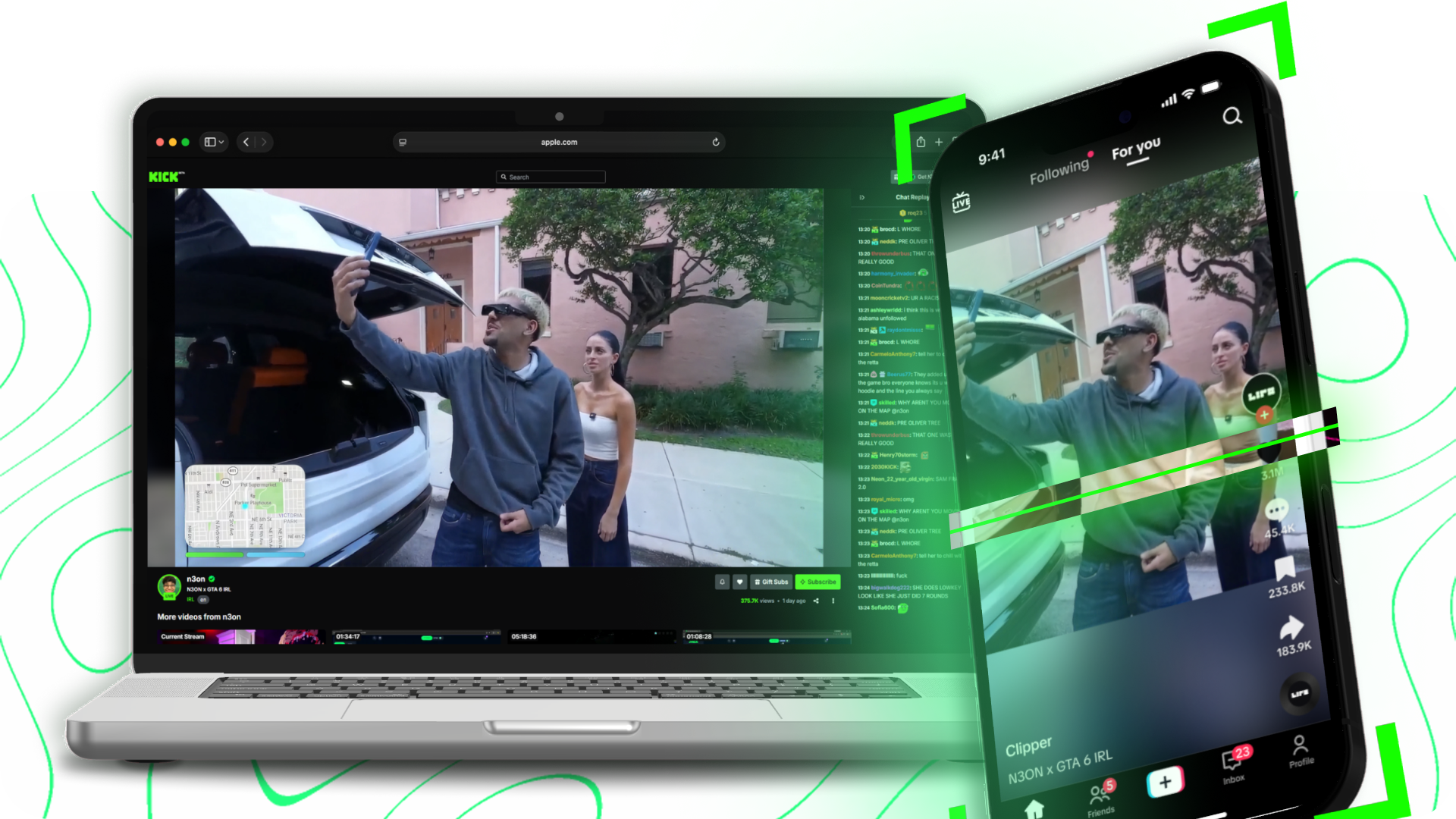
Earlier this week, Business Insider shared an article on N3on. For us, it brought something familiar back into focus.
N3on's million-dollar clipping campaigns have run on Starlet since 2023, generating millions of views worth of short-form content across the internet, and they continue today.
We're proud of that work, and we're not shy to say it. N3on has not only impacted our journey at Starlet, but alongside us, helped define what modern clipping looks like and what it means as the next vehicle of marketing.
But with everything new, including artificial intelligence, questions naturally arise.
Is Clipping Cheating Your Way to the Top?
The answer may seem obvious at first.
If people are paid to post your content, it must mean success can be bought.
But our experience working with creators like Adin Ross, Tfue, N3on, LosPollosTV, and Agent00 has shown us reality is far more nuanced than that.
Visibility Can Be Bought. Attention Cannot.
One of the biggest criticisms of clipping is that visibility can simply be purchased.
There is truth in that.
For generations, brands and creators have paid to be seen through billboards, sponsorships, commercials, partnerships, and digital campaigns.
Visibility can be bought.
Attention is different.
Being seen does not mean being cared about. Exposure will never guarantee interest, and because of that, reach alone does not create loyalty.
We didn't become fans of Clavicular because he got posted.
We became fans because we saw his personality, his mannerisms, went down the rabbit hole, and now we're enjoymaxxers. Sorry.
This is true in traditional marketing, and it is true in clipping.
You can fund distribution. You can create opportunities to be discovered. But you cannot force people to watch, care, cry, share, or return.
If content has no story, no entertainment value, no emotion, and no reason to spread, more distribution often reveals that disconnect faster.
We've worked with many creators over the years that have invested in clipping, but their content simply did not connect.
Even in music, major budgets, creator partnerships, award-show appearances, podcast runs, and global press to promote one album do not guarantee the same outcome.
÷ (Divide) by Ed Sheeran became a defining global success of the streaming era. Witness by Katy Perry had major visibility, but its long-term impact was remembered differently.
Promotion can create awareness.
It cannot guarantee connection.
The same applies here. You can increase the chances of discovery. You cannot force people to care.
Is Clipping Just Marketing?
Although @YapaneseAmricn has his own way of putting it, he raised a real question:
Is clipping simply another form of marketing?
In many ways, yes.
Like traditional advertising, clipping can increase awareness, create discovery, and put a creator or brand in front of new audiences.
But in another sense, no.
Modern ad platforms evolved with targeting, analytics, mature buying tools, and proper guardrails. Clipping, as a category, is still earlier in that journey.
Today, it can still feel fragmented: powerful, driving billions of views, yet underbuilt.
We believe the next phase of clipping is not just more clips. It is new categories in TV and media, better platforms, and better infrastructure.
That way, everyone can welcome the idea of this new frontier.
That means stronger measurement, better safeguards, clearer outcomes, and real trust and safety standards.
At Starlet, that is the future we're aiming to build.
Clipping Rewards What’s Already There
It's no secret that people get paid from clipping now.
But the best clips usually come from something genuine, including:
- A funny moment
- A strong opinion
- A surprising reaction
- A skill
- Emotion
- Story
- Chaos
- Charisma
- Culture
Good clipping rarely creates those things. It amplifies them.
It gives existing value more chances to be discovered, sometimes even the opportunity that moment never got the first time.
A strong example comes from music.
“Die For You” by The Weeknd was released years before it became an even bigger mainstream hit. The song was already great. It already had value. But renewed attention and broader promotion simply brought more people to hear it for the first time.
This is marketing.
Clipping does the same thing.
A moment, a story, a stream, something that was good to begin with but never got its chance, now getting its spot in the limelight.
It's why so many streamers who we've never heard of are starting to appear more often.
Our View at Starlet
We take clipping seriously, and we have always taken what we help distribute into strong consideration.
As with any distribution tool, access will always raise important questions:
- Who should be promoted?
- What standards should exist?
- How do we prevent abuse?
- How do we measure authentic outcomes?
- What responsibility should platforms carry?
We believe not every campaign deserves amplification.
The next phase of clipping is not just more reach. It is better judgment, stronger safeguards, clearer measurement, and systems built with trust in mind.
So everyone can use clipping without fear.
We believe the future of clipping should be useful, powerful, accountable, and worthy of trust.
And ultimately, that brings us back to the question this article began with:
Is Clipping Really Cheating Your Way to the Top?
No.
Cheating implies bypassing value.
That's just not what good clips do.
Whether that's the funniest clip of N3on getting chased by security guards, or a moment of N3on previewing a song on stream that later became the global phenomenon “Tweaker” by Gelo, clipping works best when there is already something worth watching.
If clipping were magic, everyone would use it.
Visibility can open doors and bring new eyes.
Only real substance makes people stay.
And what is substance? That part is subjective.
But the people who found substance in the clips we helped facilitate now likely watch N3on live on Kick, know his name, recognize him in public, or are brands now looking to work with him.
Clipping, like every other sector of marketing, has done what great marketing is meant to do.
By your friends at Starlet, the big frame.